17 March 2020

Transmemes

Redefining the meme and the replicator

Part 3 of 3: Transmemes

Html version here

Finding The Memes

Redefining the meme and the replicator

Part 2 of 3: Finding The Memes

Html version here

16 March 2020

A New Model

Redefining the meme and the replicator

Part 1 of 3: A New Model

Html version here

17 May 2016

G. C. Williams and confusion about information

Here's the intro:
"I have recently come across Georges C. Williams’ arguments for why genes and memes should be defined as information, in his 1992 book Natural Selection. I had seen quotes from Williams made by many proponents of the meme idea but had yet to see for myself how he argued that information is what genes and memes are made of. I found that Williams had a great insight into the true nature of replicators, maybe the most precise understanding that I have come across so far. However, I also believe that Williams made a slight but important mistake in his argumentation. The mistake is that Williams is confusing two very different understandings of the concept of information."

And here's the conclusion:
"I hope I have made it clear that information is an often misunderstood and a misused concept, particularly among memeticists. Information is best understood as a subjective experience that is confined to our minds (and computers’ “minds”) and does not travel into the outside world. The only thing that travels between brains are codes. Codes can be said to be informative for they have a potential to cause meaning. Codes can be transcoded into other codes and form long codical chains of trancodes. However, these transcodes are not to be considered equal in the eyes of evolution as they compete for survival. The codes that end up being truly copied, i.e. with the same medium and the same recognisable pattern, are the replicators. Replicators are typically found to be among codes exchanged between interactors. Information theory can be useful for memeticists because it studies some of the codes’ properties."

Html version here
PDF version here

25 April 2016

Three answers to three problems with memes

In her influential 1999 book, The Meme Machine (chapter 5) Susan blackmore raised three important problems about memetics.  Each problem was titled as follow: "We cannot specify the unit of a meme", "We do not know the mechanism for copying and storing memes", "Memetic evolution is Lamarckian". These three problems are still largely relevant today, as progress with memetics is proving to be slow. However I think my proposed views on memetics, which I call the code model, could help answering or clearing up some of those points.

Html version here
PDF version here

5 November 2015

Informational Memes

Objections to Daniel Dennett’s informational meme.

The concept of information seems to agree with the meme idea, and that is why many memeticists equate memes with information. This view is currently championed by Daniel Dennett himself and it is his own arguments that I want to scrutinise here. I myself also assumed that describing memes as information was a fair bet or at least that it would not hurt the meme idea. I came to discover how Dennett insists on describing memes (and genes) as information, to the point where this would be the only right way of describing memes, as opposed to codes for example. This got me thinking. Considering that I define memes as codes myself (link), I was compelled to try and find out whether the concept of information is a better way to describe memes or not. This is my attempt to better understand Dennett’s information and to find out whether information is really fit to serve as a model for memes.

PDF version here
Html version here

27 April 2015

Redefining the meme and the replicator

These are the ideas I have presented during the last memelab.
I tried my best to condense and communicate my vision of memetics. I propose a new definition of both the replicator and the meme in the hope to make memetics a more testable and falsifiable science. I would love to hear your comments.

PDF version here
Html version here
Version en Français ici

26 April 2015

Memelab April 2015

I have had the great pleasure again to join Susan Blackmore's memelab on the 18th and 19th of April 2015. Susan invited us to stay in her beautiful home to have some interesting talks about memetics.

Here are the people who came this time. From left to right:
Steven Smith, Pascal Jouxtel, Sylvain Magne, Susan Blackmore, Paul Marsden and Alan Winfield.


Among the many subjects we talked about there was:

  • leaving religion
  • the "Je suis Charlie" meme #jesuischarlie
  • the Jihadi brides phenomenon
  • the definition of the meme
  • de-darwinising culture and re-darwinising culture

As always, this was a very fruitful, intense and fun time. I also learnt how to play croquet and loved it. I very much look forward to our next memelab.

13 November 2014

Cultural Intelligence

I would like to try and explore briefly the nature of intelligence from the point of view of memetics. Still today, we struggle to define intelligence. It is quite telling to see how short and vague the definition of intelligence is in Wikipedia for example. Maybe a memetic approach to this question could be enlightening.
See article below.
You may also read this article on its own at this address: Cultural Intelligence


Cultural intelligence and more
A short reflection on the nature of intelligence
By Sylvain Magne
  1. Introduction

I would like to try and explore briefly the nature of intelligence from the point of view of memetics. Still today, we struggle to define intelligence. It is quite telling to see how short and vague the definition of intelligence is in a popular place like Wikipedia for example. Maybe a memetic approach to this question could be enlightening.
Among the many proposed definitions of intelligence, my preference goes to intelligence defined as being the ability to solve problems. What I like about this definition is that it is broad, in the sense that it can apply to many organisms and then it makes intelligence somewhat quantifiable, with measurable problem solving goals. Indeed there are many kinds of problems to be solved and therefore there are many kinds of intelligence. Our intelligence, as with all living things, is a product of evolution, and through evolution we have acquired many problem solving abilities. Of all types of intelligence, humans have excelled at a particular one, cultural intelligence. I would like to show how culture is not just the product of our intelligence, but is also a creator of intelligence.
I am going to explore intelligence through a series of rather arbitrary types, but that I think relevant to my point.
  1. Biological intelligence

Our first type of intelligence, I would suggest, is physiological intelligence. It is in the ability of our bodies to run themselves, to solve the amazingly complex problems of building organs, communicating between organs, processing energy, breathing and eating, defending our bodies against viruses and bacteria, etc. In essence, these tasks are so complex that nobody can fully understand them. Yet we perform these every day, perfectly oblivious to their inner workings. Our most advanced organ is arguably our brain but it is also the organ that we understand the least. Considering this is the place where our commonly understood intelligence is coming from, no wonder we cannot fully understand intelligence yet. We share physiological intelligence with all living things on this planet, and all species have their own tricks and ways of solving specific problems. Physiological intelligence is intelligence indeed, and the fact that it is a common gift we all have does not make it less impressively efficient.
The second type of intelligence is behavioral intelligence. Our bodies are meant to move and interact with a complex three dimensional world. We have an inbuilt intelligence that allows us to quickly learn how to best move inside our world. Our brain is the main organ responsible for our ability to achieve this. Our brains analyse the world through our senses, sight, smell, hearing, touch, taste, and can act upon the world via our muscle power. Thanks to behavioral intelligence, we can hunt, we can fight or flee, we can explore, we can reach, we can manipulate objects. Again, we share comparable levels of behavioral intelligence with many animals on this planet, and again this intelligence is of a very high quality. Even though we don’t seem to apply any conscious intelligence to see with our eyes, our brains make use of incredible amounts of intelligence to allow us to see.
Our third type of intelligence is our social intelligence. Not only can we interact with our environment, but we can also interact with each other in many complex ways. This intelligence allows us to work as communities and coordinate social structures that can benefit most of its members. Thanks to our social, emotional and psychological intelligence we can communicate with each other, work together, help each other, build together, protect each other, mate and care for each other. Again many species on our planet share comparable social intelligence. We are more aware of this type of intelligence because we actively improve it through our lives and our brains let us be very aware of it. Yet many aspects of it, if not most of it, is still happening on a subconscious level, out of our conscious reach.
  1. Cultural intelligence

Our fourth type of intelligence is our cultural intelligence. Where we share most of the other types of intelligence with many other species, our cultural intelligence is comparatively vast and unique. Thanks to the development of our brains, we can learn complex languages and many other complex cultural traits and tricks. Thanks to our great memory capabilities, these cultural traits can be passed on through generations and can be accumulated to create very advanced cultural items. These cultural items have given humans so much intelligent power that humans could be said to be incomparably intelligent, on many levels. Humans can solve more problems than any other living species, but maybe even more importantly, whatever problems humans cannot solve now they may be able to solve at a later stage by evolving and improving their culture. Cultural intelligence evolves much faster than biological intelligence.
Biological evolution has made humans very intelligent and in many ways among the most intelligent species on the planet, but today, culture is really what makes humans superintelligent.
What is a human being without culture? No culture means no language, no know-how of any kind. An acultural human is doomed to be less intelligent than the average cultural human. That is because culture gives us many tools to solve many problems. The tools that we learn when growing up are the very thing that makes us significantly more intelligent. More than people may think. In fact, if a child has not had the opportunity to learn a language during the first two years of its life, the child will not be able to fully develop its cognitive powers. Biological evolution has given us means to develop a culture but if we don’t use this, we are nothing more than wild animals. By providing an education to children, by giving them cultural knowledge and understanding, we are literally developing their intelligence. Obviously, that is true only if the culture given is actually useful in that sense.
Culture is therefore not just something that humans created, it is also something that makes us what we are today. As generations succeed generations, culture evolves faster than our DNA can, much much faster. Our current evolution as human beings is driven more by our cultural evolution than anything else. As intelligent beings we change our culture, but through education, culture changes us. Culture outlives us, it is our legacy and it is the headmaster of our future minds.
The strange thing is that although we create culture, in many ways we understand it very little. We live and bathe in culture but we do not have a wide perspective on culture. The only promising model that we have today to understand culture is memetics. Memetics embodies our understanding that culture is a complex evolving system to which darwinian evolutionary theory applies. In order to truly understand culture we need to understand it in a darwinian context, and for that we need to develop memetics.
From the perspective of memetics, humans are the product of two replicators, the biological genes on one side and the cultural memes on the other. Where our genes build our bodies, memes build our cultural minds. Our brains come readily programmed with room for “cultural programming”. On one side one could look at the genetic brain as being both the hardware of our intelligence and the operating system for it. On the other side, culture writes programs inside our brains, the software. On one hand our brains come ready with pre-installed biological programs to learn by themselves about the environment through trial and error, and on the other hand culture comes with ready made tried and tested cultural programs that help us leap forward and acquire levels of intelligence one could not reach without it.
Today our brains are meme machines as much as they are gene machines. Every time we are exposed to memes they are sculpting our brains bit by bit. Our minds, the way we think, the things we know, the tricks we learned, the language we speak, the skills we perfected, all have been programmed by a mixture of experience and exposition to cultural memes. Without memes, you would not play or hear music, without memes, you would not speak, you would not read, there would be no movies to watch, no paintings, no art, no tools, no science, no history, no stories. Without memes, you wouldn’t know how to cook, you wouldn't know how to dance, you wouldn’t know how to take care of your health or your children, you wouldn’t know how to build a home. Without memes and culture to program our brains, we would be damn stupid.
  1. Technological intelligence

Now, evolution doesn’t stop there.
There is a fifth type of intelligence which is growing rapidly, and that is technological intelligence. Technological intelligence is the result of problem solving artefacts, also known as tools. Since we created tools, tools allowed us to solve more problems, such as how to build homes or hunt more efficiently, etc. For a long time, tools were guided directly by our brains, as a sort of extension of our bodies. But now tools have become much more sophisticated. Tools have grown brains of their own with which they can achieve things that are simply impossible for our brains and bodies. Thanks to technology we fly, we cure diseases, we make complex calculations, we see the infinitely small and the infinitely large, we communicate through space and time, we accomplish feats comparable to magic.
This fantastic technological intelligence is the direct product of cultural intelligence, and the way it is going, it is bound to surpass our own intelligence in every way.
Where technological intelligence has not already surpassed us, it is catching up with our biological intelligence at an amazing rate. All of the types of intelligence I mentioned above are steadily being acquired by technological intelligence. Their physiological intelligence, for example, still looks rough compared to how complex body cells are, but in many ways, machines have already many great features. Where cells can create tissues, these tissues are also fragile, whereas machines are comparatively extremely strong. But where cells can mend tissues and defend themselves, machines are still unable to even start doing that. Where cells are tiny and working at the molecular level, machines are very cumbersome and rough. This said the future technologies such as nanotechnologies are looking to do just that, and even if it takes some time to get there, it’s only a matter of time, and in biological time, it’s just round the corner.
Where behavioral intelligence is concerned, again there are things machines do far better than us, like moving at high speed, flying, carrying weights, etc, but then, as surprising as it may be, no machine can walk like a human can. After many years of research such seemingly simple behaviour is a real challenge for machines. But again progress is being made, we are seeing the first machines walking up stairs, or running in fields like a horse would do. Again, machines are picking up speed and catching up fast. Another great hurdle for machines is vision. In order to move well, machines need to see well. The complexity of this task is enormous but again every day sees new progress on this front, and where we only see a limited portion of the light spectrum, machines will see a lot more, in more detail, in many more dimensions.
Social intelligence is something still very new to technology. Social interactions between machines and humans is something we’re only just starting to explore. The most blatant progress is made by smartphones. These little techno pets that we carry around can hear us and “understand” our vocal instructions. They can also talk back, recognise our facial expressions and more. Machines, it could be said, are slowly becoming social machines, but there is much room for improvement still.
Finally, cultural intelligence in machines is practically inexistent. Humans are still today the main creators of cultural content and only on occasions are machines allowed to learn from each other, teach each other or exchange “techno cultural” items. Despite that, it is already in the air and work is being done in that direction. We are looking at creating machines which could learn on their own, pass that information onto other machines and come up with creative solutions to previously unknown problems. This is leading towards what we commonly call artificial intelligence.
As you can see, technological intelligence is growing fast, in all directions, and it may be relevant to try and anticipate the effects of such rapid growth.
  1. Conclusion

Intelligence in my view is the result of the evolution of problem solving capabilities. Through the ages, natural selection has allowed for many biological types of intelligence to emerge. Then something radically new happened and cultural intelligence emerged in humans. Culture evolved at a comparatively much faster rate, making us more intelligent but also giving rise today to yet another new type of intelligence which is technological intelligence. All of these types of intelligence are the byproducts of underlying evolutionary processes. Darwin’s theory of evolution has given us a tool to understand biological evolution and now we need a new tool to understand cultural and technological evolution. We need them because today things are moving and changing so fast that the problems that we will face now and in the future are coming to us faster and harder. We need, somehow, to see them coming. Our best chance at understanding the dynamics of cultural and technological changes is memetics.

6 November 2014

Memelab Autumn 2014

So I had the pleasure of joining the latest session of Susan Blackmore's Memelab which took place on the first and second of November 2014.

It was a fun, inspirational and enlightening experience. The idea of the Memelab is very simple. It is a rather informal gathering of people interested in discussing the subject of memetics. There were seven of us this time, coming from various backgrounds and different parts of the world. The only rule to this event was a schedule planned so that each participant had a chance to lead the discussion one way or another for an hour. 

This time, Memelab took place in Bristol:


Alan Winfield hosted this session in his own house and made everyone feel at home. It made for a charming weekend indeed.

We discussed many subjects during this session. Here are a few I can remember:
  • Martin was interested in understanding how advertising fatigue may occur and if we develop some kind of immunity to memes in advertising.
  • Rachel wanted to explore how simple drawings get affected by successive hand copying.
  • Susan, was asking what should be done to inform the world about the fast approaching reign of technology.
  • Alan introduced his work on ethical robots.
  • Andrew introduced us to his PHD work on memetics and religion.
  • And myself I tried to emphasise the fact that we find it hard, still today, to define memes.

I enormously enjoyed this event and very much look forward to renewing this experience.

Here is the list of participants:

Susan Blackmore


Alan Winfield


Martin Farncombe


Rachel Cohen


Andrew Atkinson


Marina Strinkovsky


Sylvain Magne


29 October 2014

Why memetics has to work.

In May 2014 a meeting took place at the Santa Fe Institute gathering some of the prominent scientists and philosophers on the subject of cultural evolution. It was organised by Daniel Dennett and aimed at discussing agreements and disagreements over the views and models of cultural evolution.


Each participant wrote a short note on their personal experience of this event, often focussing on areas of agreements and disagreements.
All notes can be read at this address: Santa Fe Workshop

As these sort of events are rare I was eager to hear how it went. I read all the articles and notes that followed the event and was left with a very strong feeling that the popularity of memetics is seriously on the decline, or that the people present were starting to turn their backs on memetics if they had not already buried the whole idea.

Here’s what Dan Sperber said in his summary:

  • "There have been great insights in Dawkins’ whole idea of memes even if it failed to spawn a successful scientific program."
Read Dan's full note here: Dan's thoughts

One can sense here that Dan Sperber really wants to put the final nail in the coffin of memetics, describing it, in a past tense, as a failure. Reading all participants’ notes, I felt like he was not the only one thinking that way and that even Daniel Dennett himself, usually a fervent advocate of the meme idea, seems to move away from memetics and embrace more the ideas offered by the other scientists. Now that Richard Dawkins himself is showing signs of being (as Tim Tyler would say) a reluctant apostle of the meme idea, it seems that Susan Blackmore is left pretty much alone to defend the meme's eye view on cultural evolution. Sue may be the last true memeticist standing.

Read Susan's thoughts on this event here: Susan's thoughts

I have to say that I feel sad and somewhat alarmed by this new trend and I wish more than ever to prevent the collapse of memetics. The reason I don't want us to give up on memetics is because there is a logical reason for which memetics ought to work. If we follow a logical chain of thoughts, it's not up to us to decide whether memetics is real or not, it happens that memetics just has to be true. If it turns out that memetics is not true then it may have some serious consequences for the theory of evolution itself. That is why we need to pay more attention to this issue, and not discard memetics as if it were just a fad. Let me explain further.

Memetics is part of a larger picture which is the theory of evolution. 

The theory is based on simple principles, which Susan Blackmore do well to remind us of regularly. These are heredity, variation and selection. Indeed, when we have those elements together we necessarily have evolution. This idea has been formalised a little further with the concept of the replicator. The existence of the replicator along with environmental conditions is what allows for evolution to take place.

The theory of evolution relies on these concepts to be true and universal, as Richard Dawkins himself has pointed out. That is actually the very reason why he looked for another replicator than the genes, in order to show the universality of the concept. He was right to chose culture as an example. Sure enough he didn't have much choice, but at least culture exhibits all the signs of evolution. In Fact the evidence for cultural evolution is so overwhelming it was actually used as an argument for biological evolution. So, undeniably, culture evolves.
If culture evolves, it can only mean one thing, it must obey the laws of darwinian evolution, and it means there has to be some replicators at the heart of cultural evolution. Not just a few loose replicators, no. The cultural replicators need to be the cornerstone of cultural evolution. At least that’s what the theory leads us to expect.

So what if those memes, those cultural replicators, were nowhere to be found? What if memeticists failed to make a convincing case for memetics? What would happen then? 

What I want to argue is that if it were the case we would have a bigger problem than we would like to think. It wouldn't be just a case of “oh well, memetics doesn't work, forget about it then”, no, if memetics were to fail then this simple fact could falsify the whole theory of evolution. In a ricochet effect, the problem would bounce back to the theory of evolution and force us to question Darwin’s own ideas. Why is that?

Let’s take an analogy to understand better what is at stake here. 
If one considers triangles, one may notice that the sum of all 3 angles of a triangle adds up to 180°. From this observation one would naturally extrapolate that probably this fact is true for all triangles. As a matter of fact it is true and this can be considered as a fundamental law for triangles. Now what would happen if someone, one day, were to find a particular triangle that does not obey the 180° rule?
One cannot just say, “Ah well, the rule applies to all triangle but not that one!”. That would be unsatisfactory because one would still need to account for the existence of that strange triangle, and it wouldn’t help us finding out whether there are other triangles that also violate the rule.
In fact, if this were the case, mathematicians would have no other choice but to reconsider the 180° rule itself. They would think that maybe the 180° rule is not complete and that, surely, it should be reviewed. In other words the 180° rule would be falsified, proven to be false.
That is exactly what is at stake here between memetics and the theory of evolution. If memetics cannot be proven to be true, then this questions the validity of the theory of evolution. It potentially falsifies darwinian evolution.

So at this point it can go one of two ways, either we work it out and show how memetics is a valid model for cultural evolution, or we go back to the drawing board of theoretical evolution and fix the problem there. Either scenarios are possible indeed. In fact even if we were to be forced to go back to the theory of evolution, it doesn't mean that it is entirely false but maybe only incomplete. Let me continue my analogy to explain this point.

There are actually some triangles that do not obey the 180° rule. Proving it is very simple. If you were to draw a triangle between let’s say London, Tokyo and Sydney, by drawing lines on the surface of the planet that join these cities, you would find that the sum of this triangle’s angles exceeds 180°. Now how’s that possible? The reason for this is that the surface of the earth is curved, non-planar. The 180° rule only applies to a Euclidean space, where lines are straight. The surface of the earth is a non-Euclidean space where the lines of the triangle are curved. In such spaces, the rule does not apply any more. So what we find here is that the 180° rule has to be completed in order to work. We need to add a condition to the rule which is that it only applies to a Euclidean space. Once this is understood, then the mystery is solved.

So, going back to the theory of evolution, it may be that we just haven’t found the right angle for memetics yet or it may be that we need to make some adjustments to the theory of evolution itself. I have my own opinion on what needs to be done, but I believe this is the very reason why we cannot give up on memetics. If we do give up on memetics, then we have a logical obligation to account for why it doesn't work and that means going back to the theoretical board of darwinian evolution.

As it stands, my own approach to memetics has led me to work on the concept of replicator. I find that as it is, it lacks definition in order to build a good model of memetics from it. I hope to show with my work that all of this can be done rigorously, and that memes are real indeed.

29 August 2014

MEMELAB

Soon I will have the pleasure of joining Susan Blackmore's Memelab.


It consists in a small gathering of memeticists who enjoy discussing meme matters over a couple of days.
You will find more information about the Memelab on Susan's website:

http://www.susanblackmore.co.uk/memetics/memelab.htm

I am honoured I will be able to take part this time and enjoy everyone's wisdom.
It should happen some time in October.
I will then try and let you know how it all went.

25 April 2013

Tim Tyler

Tim Tyler is without doubt one of the most meme literate people I know.


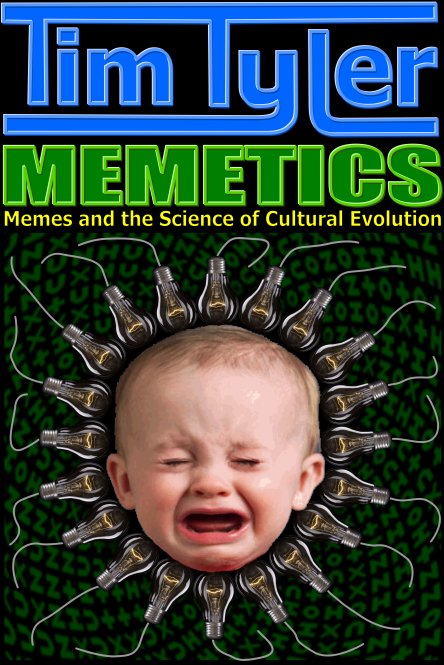
Tim is extremely active on the subject and he is also the author of Memetics, Memes and the science of cultural evolution :
http://memetics.timtyler.org/


Which I have yet to read though. Shame on me!

Tim is always full of clever insights and a pleasure to read. His understanding of evolution, universal Darwinism and memetics is very deep and he always strives for a a better communication and public understanding of those topics.

I strongly encourage you to follow his blog on which he posts regularly:
http://on-memetics.blogspot.ch/

Finally you can also watch some of his many videos on youtube:
http://www.youtube.com/user/eggtin/videos?view=0

As Tim would say: Enjoy !

24 April 2013

Why meme logic ?

I am not trying to reinvent memetics.

All I am trying to do is to go into a little more detail and add those missing brush strokes in order to cast away the doubts.

Why ?
Because although the reality of memes is obvious to some of us, it is not so to a lot of people.

Why bother convincing people and detractors?
Because science is not a matter of faith, it is a matter of facts. We need to bring in the facts so that we cannot doubt anymore, so that we know.

2 April 2013

Copy or not copy ?

Next important concept to clarify: the copy.
It seems straightforward, but still, one needs to define it well in order to minimise misunderstandings. Here's my attempt at defining the copy based on the previous definitions.
Again, your comments are most welcome.
You can also view the article below with this link : The Copy
Or go back to the contents list : Contents

The copy
Copy or not copy?
By Sylvain Magne
Now that we have shown that everything is code, the question ensues: what makes a particular code a replicator? What sets a replicating code apart from other codes?
In the world of codes there are all sorts of codes that have for effect to change the world in all sorts of different ways. That’s what particles do when they interact with one-another, they keep transforming the universe by attracting each-other, repulsing each-other, bouncing, breaking, merging, spinning, etc. Of all the possible interactions in the world, some may lead to remarkable outcomes. It is the case of the replicator. The particular effect of replicators is that their interaction with a reader leads to the creation of a copy of the original code. Consequently, the next question that needs answering is:
  1. What is a copy?

I have found that such a simple word is not as clearly defined as one may think. Just like we did with the “entity”, we need to define the “copy” more precisely in order to make more sense of the concept of replicator. As I was looking for definitions of “copy”I stumbled upon one that I particularly liked, and that is Google’s definition of a copy . I liked it for its clarity and simplicity, so let’s start with that. Google defines the copy as :
A thing made to be similar or identical to another.
I like this definition because it is very large and encompassing and yet very simple, very much like Richard Dawkins’ definition of the replicator. Only Richard Dawkins may have used the word “entity” instead of “thing”.
There are three elements to be considered here. First there is the copy, here referred as the “thing”. Then there is the original code, here referred as “another” thing. And finally there is a copy maker responsible for the “made to be similar or identical” part. Again this definition seems very straightforward, but we need to understand clearly what each of these elements mean.
  1. What’s that thing?

According to the code centered view of the world that we chose in the previous chapter, the “thing” ( which is equivalent to Richard Dawkins’ “entity” ) is necessarily a code, simply because anything can be regarded as a code, and that is true for the original thing too. So what we are talking about here are copies of codes.
  1. Where is the copy maker?

If any copy is to be made, it needs to be made by a device that can perform actions. Again, as we have seen before, if we have codes we necessarily have readers, and readers can indeed perform actions. Therefore, the copies will necessarily be made by a reader. In other words, anything that makes copies of some code is a reader. For example, in genetics the copy maker is the human body copying genes. In computer science the copy maker is the computer copying programmes. In the printing industry the copy maker is a photocopier copying pages of text and images. In the world of art the copy maker is a painter copying paintings. And so on .. This means that cells, computers, people and photocopiers are all readers.
Just like for any code, the very existence of a copy implies the existence of a reader capable of making copies.
  1. Made to be.
Note how the definition says “made to be similar or identical” and not just “similar and identical”. This implies that things that just “happen to be” similar or identical will not qualify as copies. This point is crucial. For example, two identical molecules in the universe that happen to be the same are not necessarily copies of each other. So what is the difference between something that happens to be similar and something that is made to be similar?
The difference lies in the fact that the original code needs to have been fully involved in shaping the copy. To the point where if any part of the original is missing, the copy will fail. Quite simply, the only way to make a copy with certainty is to make it by letting the original code guide you through the copying process. The reader making the copy needs to read the entire code if it is to copy it faithfully. All the aspects of the copied code will be influenced by the original code and nothing can be left to chance in the copying process because if any part is left to chance, that part fails to be a copy, except maybe if by chance it is similar.

This said. How perfect does a copy need to be exactly? And what would it mean for a copy to be perfect?
  1. Similar or identical?

Now, as memeticists, we have a problem with the mentioning of “similar” versus “identical”. It seems fair that the definition says “similar or identical” because we are used to seeing imperfect copies around us and still consider them as copies. Unfortunately, we may not enjoy such flexibility when talking about replicators. Indeed, Richard Dawkins has explained clearly why, when talking about replicators, the copy needs to be identical. There are two simple reasons for why replicators need to be identical :
  1. First, in the case of genes, if one single bit of a gene changes it can cause the gene to have a dramatic effect on its host, possibly deleterious. Therefore loosely copying genes is not a good idea.
  2. Second, genes compete with each other for a chance to survive. On the rare occasions when a gene mutates, this new mutated gene enters the arena, the gene pool, as a new contender which could eventually replace the original gene. The original gene and its new mutated versions become instantly alleles and therefore compete for the same spot in the gene pool. Therefore the new mutated gene cannot be considered as a copy of the original for the fact that it competes with the original.
That is why one single alteration in a gene makes this gene a failed copy, and that is why the copying process needs to be perfect. Not only that but that logic applies to all replicators. Indeed if a replicator, whatever its nature is copied loosely, the new failed copy becomes a new contender and cannot be considered a copy. Therefore we find ourselves with the necessary following rule:
  • The copy needs to be identical to the original code.
Now the question is: can memes actually comply with this and be perfectly copied?
Meme fidelity is a big issue. This is one of the major challenges that memetics is facing since the very beginning, and is still unresolved today. I hope to show here how we could solve this puzzle. From our daily experience we can see for ourselves that a lot of the ideas and cultural traits around us don’t get copied very well and yet seem to spread somehow. Can we create a meme theory that accounts for this loose copying process or do we need to change the way we understand memes? If replicators are meant to be perfectly copied, is a meme theory even conceivable?
The point I am going to make here is simple. I want to show that perfect copying is relative and that, taken from the right point of view, a seemingly lose copying process can appear as a perfectly accurate process, consequently re-establishing the concept of replicator as a valid model for memetics. The solution I am offering lies in a particular branch of mathematics, fuzzy logic.
  1. Fuzzy Logic is not fussy.

Fuzzy logic is interesting to memetics because it gives us a tool to deal with the fact that the world is not perfect. Fuzzy logic and probabilistic logic are crucial to the world of codes and mathematics. Fuzzy logic is no less rigorous than traditional mathematics, it is entirely part of mathematics, with its own set of laws. Fuzzy logic is a tool which accepts that data and calculations can be imprecise, incomplete or mixed up. The world we live in is very much like that indeed. On one hand there are things that we can count in a very binary fashion, like the number of apples on a tree for example, and on the other hand, we sometimes need to measure approximately quantities such as the weight of apples. Unfortunately, where you might be able to give a precise count of the number of apples, there is no device in the world that can give you the exact weight of an apple, simply because any instrument used has a limited precision.
To be fair, even counting apples on a tree is not that straightforward. What do you make of apples that are half eaten by worms or apples that are not fully grown or apples that are rotten? As a matter of fact there is no counting or measuring in this world that can be done perfectly. Even at the level of elementary particles where quantum physics take over.
For any measurement that we make we need to accept a certain level of uncertainty, of fuzziness. Scientists are fully aware of that fact and have to deal with it constantly. Scientists work really hard to measure and reduce the fuzziness of their objects of study in order to gather reliable data. The consequence of this fact is that, if it is impossible to measure something perfectly, then you cannot determine perfect copies. My point here is that a perfect true copy, a replicate, cannot actually exist. No matter how precise your tools are you cannot create an absolute replicate. Ultimately, even if you copy an object atom by atom, as genes do, quantum physics will not allow for the copy to be exactly the same simply because the atoms will move differently in both the original gene and the copy.
So, if there is no such thing as a replicate, what are we to make of the concept of replicator itself? Can replicators actually exist at all?
Well, as a matter of fact, this fuzziness of the world doesn’t stop us from counting apples and hasn’t stopped us from building computers. Somehow our brains can still count apples and our computers can still count bits. How does that work?
It works because, although there is fuzziness, there are also ways of reducing fuzziness, or simply ignoring it. Our brains and our computers can tolerate a degree of uncertainty. If you are a farmer and you are picking the best apples to sell on the market, your brain will look for features and characteristics in the apples that will allow for certain apples to be selected and others not. The brain will define a threshold between green, yellow and red for example and apply that threshold in order to pick the apples with the right colour. A computer will do the same. Within computer chips there are loose electrons that can add background noise to the data. To avoid the noise disturbing the reading of the data, computers have a threshold that will allow for slight fluctuations in the signal and, as long as those fluctuations aren’t too extreme, the signal can be read perfectly despite the background noise.
Thus, despite the fuzziness of the world, our fuzzy-ready brains manage to make sense of it. Similarly, despite the agitation of particles at the gene level, genes still manage to stick together. This tolerance to fuzziness is what allow genetic codes and computer codes to be copied in a way that can be considered “good enough”. The copies are not exact in the absolute, that is a fact, but within the range of tolerance of the gene machines and computers, these copies can still be regarded as identical.
What does fuzzy logic tells us?
  • Fuzzy logic tells us that even though there is no absolute copy that can exist, perfect copies can still exist in a relativistic point of view.
Now what is that point of view exactly and what does it take for a copy to be regarded as good enough?
  1. The reader’s point of view.

The replicator is tied to the concept of copy because a replicator simply has to get copied to be a replicator. Not only does it need to be copied, but it needs to be copied well enough. Now who or what decides what is a good enough copy? How can we determine whether a copy is successfully created as such?
For example, how will you determine if a copy of your front door key is a good copy? Well, you will simply try it on your door and see if it opens the door. It seems obvious to say that it doesn’t matter if your key doesn’t open other doors. The only point of view that matters is whether it opens your door and is compatible with the keyhole in yourdoor. Furthermore, the copy doesn’t need to be perfect in every aspect. If your original key is made of iron, but you used copper to create the copy, the key will still work. It won’t matter whether the key is made of iron or copper, or whether it is blue or red. The only thing that matters is for the key to have the right shape and to be strong enough to open the door it is meant to open. This idea can be generalised to any kind of copy. Copies only need to work from a certain point of view which is their reader’s point of view. A Macintosh computer is not fit to say if a PC programme is copied well. Similarly, a camera is not fit to decide if a sound wave is correct. A reader that is fit to make such judgement is a reader that is compatible with the code that we want to evaluate. In the same way that a human gene is evaluated inside a human body and a computer programme is evaluated by compatible computers, all codes and copies need to be evaluated by their compatible readers.
So the best way to determine if a copy is a good copy indeed is to use the right reader. To test the quality of a copy, you simply need to run it through the reader. If when running it through the reader the copy reads just like the original, then the copy is a true copy. Running the original code or running the copied code should result in indistinguishable outcomes. But again, only from the point of view of the reader. That is precisely what a computer does when making copies. It verifies the copy by reading it through the same process as the original and checks if it reads the same way.
As a result:
  • The only meaningful point of view to judge the quality of a replicator is the point of view of its reader.
  • From the point of view of the reader, true copies and replicators can exist.
This is how the concept of copy and replicator need to be understood, if they are to make sense. They need to be understood in a relativistic manner. The quality of codes as replicators is defined by their relationship with their readers. If from the reader’s point of view a specific code is seeing itself successfully copied over and over then it deserves to be labeled a replicator. Judging it from a different point of view could be misleading. You may think that two keys are different because they are coloured differently when in reality they can be regarded as identical from the viewpoint of doors and keyholes.
Therefore there is hope for replicators to exist. If we take the right point of view, we can hope to find true copies of genes, of computer programmes and cultural traits. And that is the very reason why the replicator idea may still work for memetics.
  1. Analog, Digital and Timescales.

Note that the example of the key is not a perfect example because of the way copies of keys are made. After several successive copies of a key, errors will eventually accumulate and the shape of the key will eventually fluctuate. Maybe, after five or ten copies the latest copy may actually fail to open the door. The reason is that the information stored on the key is analog and not digital. The problem with analog codes is that, unlike digital codes, there is no noise reduction system that can allow for the code to be copied perfectly. Analog codes have no inbuilt tolerance for variations like digital codes have. Digital codes are digital in the sense that they are broken down into smaller bits that can be stored and deciphered easily, so that even if the data suffers slight variations, the shape of the bit remains readable. When copying digital codes, we don’t copy every details of the medium carrying the code but we only need to copy the sequence of bits and reproduce that sequence faithfully. This reduces the amount of information needed to make the copy because one can ignore the imperfections of the medium. In the case of analog codes there are no bits that are easily recognisable and therefore every minute aspect of the medium becomes relevant and needs to be copied in order to preserve the code. The problem is that the amount of information needed to copy that code is actually enormous and makes it impossible to be copied exactly. Consequently every copy will suffer some amount of data loss.
An analog code is therefore doomed to fail eventually. What kind of replicator would that be then? This problem is true for all analog recordings and this important point will need to be addressed when redefining the memes. The question this raises is whether memes have an analog nature or a digital nature and how this impacts their replicating abilities. If analog codes are doomed to fail then can they be considered as replicators? In the case of keys, one can’t deny that there is a potential series of copies that will live on for a while. If one considers replicators over a short length of time, then there may be some codes that qualify, but then when considering a larger length of time those codes may not really qualify as replicators if their survival is too short to be significant.
What I am trying to say here is that the nature of a replicator depends on the timescale one may consider. There will be more codes that can qualify as replicators on a short length of time than on a longer one. Simply because codes that can live longer will tend to be more rare. These aspects of evolution can be witnessed in biology. Depending on the timescale, the length of the bits of dna that qualify as replicators will tend to be longer for short periods of time and shorter for long periods of time. The reason is simple, and that is because of the way genes are shuffled in the genepool through sexual reproduction. The more generations of offsprings the higher the chances that a gene may be cut in half and therefore fail to be passed on in its entirety.
Realistically, one can expect replicators of digital nature to be favored by natural selection over analog ones. Also, one can expect that fact to be true for memes as well. Analog memes would tend to be short lived and may not really qualify as replicators. Let’s just hope that memes are more digital than analog if we hope to apply the theory of evolution to culture.
  1. Conclusion.

To sum things up, let's give ourselves our own definition of a copy. It could go like this :
  • A copy is a code made to be identical to an original code, by and from the relative point of view of a reader.
With these new definitions of the terms “entity” and “copy”, we now find ourselves with a new relativistic and more precise definition of the replicator. I believe this definition is compatible with the gene theory and can help opening the doors to a science of memetics and also defining better what Susan blackmore calls temes. We may find that this new definition of the replicator could change not only our perception of memes but could also change somewhat our understanding of genes as well.
Let’s dive into these questions with the next chapter : The new replicators (link coming soon)


24 December 2012

The entity

Finally getting into the details of redefining the replicator. Here we will define Richard Dawkin's "entity" as a code. Comments are very welcome.

You can also view the article below more comfortably with this link : The entity

The entity.
All is code.
By Sylvain Magne
In this chapter, I want to show that the “entity” that R. Dawkins refers to, can be understood as a code, a kind of computer program. And this, whether we are talking about actual computer programs, or genes or cultural traits. I will first remind us that the theory of evolution itself is an algorithm, a kind of code. I will then show how we can rigorously look at the universe and understand it as a pile of codes, by taking what I call the code’s eye view on the universe. Once R. Dawkins’ entity is understood as a code we can finally start describing this elusive “entity” in more practical details.
  1. Evolution is an algorithm

As a matter of fact, the theory of evolution and the concept of replicator are models based on algorithms and mathematics. Mathematics are fundamental to any science indeed but algorithms and computer programs become more and more important in modeling our understanding of the universe. It turns out that algorithms are more universal than one may think at first.
  1. Definition of algorithm

An algorithm consists simply of a series of well defined step by step operations. The concept of algorithm is central to any computing process. Quite simply, every computer program is an algorithm or made of algorithms. But algorithms are also part of our everyday life. A recipe is a form of algorithm as well, and so is a guide to build a piece of furniture or the rules of a board game. These algorithms tell you how to go about executing a specific task with a simple set of rules. Algorithms can also be found in nature. Within the living cells, the replication of DNA molecules follows a very precise step by step algorithm.
  1. Evolution, a recursive algorithm

Algorithms can be “run” once or many consecutive times. By brushing one’s teeth everyday we are using a recursive algorithm. Recursive algorithms are simply algorithms that are typically run again and again. For example, when creating a puff pastry one needs to flatten and fold the dough many times over, thus repeating a simple algorithm in order to create the thin layers of the pastry. Learning a poem by heart through repeated reading and recitation is also a recursive algorithm. With regard to evolution, it is through generations and generations that the genes get selected by natural selection, undergoing the same recurring selective process. Evolution is therefore the result of recursive algorithms.
  1. A replicating recursive algorithm

The particularity of the evolutionary algorithm is that it is circular, by the fact that it applies to itself, making copies of itself, the copies then make more copies of themselves and so on allowing for a continued process that can potentially go on forever. This way, genes make copies of themselves through reproduction into new generations that will, in turn, make copies of themselves, thus allowing for populations to grow and spread. Evolution is a rather simple algorithm that anyone can grasp easily. There is nothing difficult to it. What can be more difficult to grasp is the effect, on the long run, of recursive algorithms, especially when errors and accidents happen along the way, which is the case in nature. Life has been going on for a long time and the algorithm of evolution has had the leisure to run many times indeed. A lot can happen in that time, so much that it can lead to the complexity of life that we know today.

All of this to say that evolution is an algorithm and that the algorithm’s perspective may well be the best angle to study evolution. So let’s try, before we take the point of view of the replicator, to take the point of view of algorithms.
  1. All is code

As it turns out, algorithms are more than “just algorithms”. They’re not just something that sometimes happens to be an algorithm. Indeed, if one looks at the universe from a certain point of view, then everything is algorithm. Or so mathematics say.

Algorithms are nothing else than mathematical objects. Mathematics is the best and only real tool that we have to model the world around us. Mathematics are fascinating for the fact that they allow us to model the world in such simple and elegant ways. A simple mathematical formula can explain and predict the movements of planets with perfect accuracy and scientists find it very efficient to look at the world and make sense of it through mathematics. Evolution is no exception.

Now there are two slightly different angles that one can use to look at the world. Since the boom of computers and their ability to run algorithms we have had a rather new perspective on the world which, in some cases can be easier to grasp. For example, one equation will not be enough to model the formation of galaxies but by using computers and complex algorithms we can simulate the creation of galaxies with our desktop computers. This new approach would simply be impossible and out of reach without the use of computers. Algorithms help us understand the workings of such complex systems as galaxies, the weather, evolution and many complex chaotic systems.

However, the relevance of algorithms goes even further. In fact it has been shown that the relationship between mathematics and computer algorithms is more fundamental than expected. The French mathematician and neuroscientist Jean-Louis Krivine has changed the way one can look at the universe in a rather revolutionary way.
  1. Mathematics' equivalence

Jean-Louis Krivine has helped greatly to demonstrate mathematically the equivalence between maths and a particular programming language called Lambda Calculus. Strictly, for the purpose of this argument, it doesn't really matter to know what the Lambda Calculus is. What is important is to understand what the equivalence means. Basically, J.L.K.’s equivalence means that for all mathematical theorems there exists a computer program that is equivalent, and reciprocally for every computer program there exists an equivalent mathematical object. As a result, there is a strict equivalence between maths and computer programs, in other words, maths are computer programs and computer programs are maths.
  1. The universe is made of codes

What this fact implies is that where we may understand things mathematically, we can also understand them as programs. Science has shown us how we can look at the world and understand it in mathematical terms, in other words, with equations. What J.L.K.’s equivalence tells us, is that we can just as well and rigorously change our perspective and look at the universe as if it were a computer. The laws of gravity, quantum mechanics, and every scientific laws are indeed equivalent to computer programs with this particular fact that the programer and the computer are one and the same, the universe itself. In other words the universe is a giant computing system constantly firing lines of codes.
Now, it’s all very well but why would it be interesting for memetics to look at the universe as a computer? Why take the point of view of the code?
  1. Why take the code's eye view?

The point of this is to show that R. Dawkins’ “entity” can be understood as an algorithm, or a code, simply because, as we have just seen, anything in the universe can be understood as a code. The good thing about this is that, unlike the elusive “entity”, the code is something that we can hope to study and understand. We can now try and see what we can learn about replicators from the fact that they are codes and not just vague “entities”. We can now hope to lift the misunderstanding that stems from the mysterious “entity”.
Also depending on what subject scientists are studying it may be easier to take one view or another. When it comes to the movements of planets, a purely mathematical approach may be simpler, but when it comes to chaotic systems such as the weather, algorithms are more practical. It is easy to see that, when studying genes, the code’s eye view may come more naturally, simply because genes are codes and because of the complexity and chaotic nature of it all.

Now that we know that entities can be understood as algorithms or programs or codes, we should hope to use our “code goggles” and reinterpret the concepts of genes and memes. If we know better what a code is, we’ll know better what genes and memes are, right?
So do we actually understand what algorithms and codes are? Again, we’ll have to agree on what a code is exactly in order to be as clear as possible on the nature of replicators. I would like to be sure that we have defined the core concepts of the replicator as accurately as possible. It would be no use replacing the word “entity” with the word “code” if one could not define the latter precisely. In the next chapter we will try and define the codes the best we can.
  1. The code

I have already used several words to talk about codes, such as algorithm and program. I will use the word code instead of algorithm or program for it is less specific to the realm of computer science and applies in practice to more fields. Now the question is; what is a code exactly?

Unfortunately, there is no universal definition of the code, at least none that I know of. This means that we may need to offer our own definition. There are for sure many uses for the word “code” in a wide variety of cultural fields. For example, we speak of highway code, dress code, secret code, penal code, code of honour, bar code, zip code, genetic code, computer code, code of conduct, etc.. the list goes on. On top of that there are many synonyms of the word "code" such as "rule", "law", "theorem", "principle", "policy", “directive”, "program", "algorithm", "recipe", "method", "procedure", etc.
Here, I wish to use the word code to talk about all and any of those types of code. Remember that at the end of the day, all is code. So In order to agree on the meaning of code and for the purpose of better defining the concept of replicator it is important to define the code as precisely as possible. Yet, what I am looking for here is the most general definition possible, a universal definition of code that would be central to any type of code and still be very precise.
In order to be coherent I will start by considering the computer code. After all, this is the code that was shown to be equivalent to mathematical objects and therefore most universal. Given a computer code, what could we say about that code?
Quite simply, a computer code could be said to be a set of instructions. Indeed, all there is in a computer code are series of commands written in computer language for a computer to read and execute, nothing more nothing less than instructions.
By definition, the very existence of a computer code implies that there should be a computer to read that code. If there were no computer to read the code in the first place, there could be no code for it. What else than a computer can read a computer code? This also implies that the computer code is written in a specific language. There are many computer languages and if the language used is not right then the code is unreadable. Also, let’s not forget that computer codes don’t float up in the air, they need a disc or some kind of memory device to be stored on.
All of these elements, such as a storage device, a computer and a compatible language are necessary elements for the code to exist and make sense. They are in fact inseparable. If one of those parts were to be missing, the code would be meaningless. But that’s not all. There is one last piece that is important. The computer which is reading the code needs to be able to perform actions accordingly to the instructions of the code. If the computer could not do that it would be exactly as if it weren’t actually reading the code, it would be as if it were blind, and therefore it would actually simply fail at being the reader of the code. By necessity, the reader needs to be able to perform actions, the very actions that the code commands.
I believe there is no need for anything more other than these conditions to be true for the code to exist. All these parts are necessary and sufficient for a code to be.
I also believe that these elements are necessary for all types of codes, computer codes and others. Take the genetic code for instance. Its medium is made of chains of nucleotides, the reading of the code is done by the cell hosting the genetic material and acting as a computer, the genes need to be written in proper genetic terms to be able to instruct the cell correctly, and finally the cell needs to be able to read and act accordingly to the code. In the same way as the computer code, the genetic code would be lost if any of the reader, the medium or the language were missing or faulty. And again the same could be said of a cultural element such as a recipe for example. Its medium would be the paper and ink it is written on, the reader would be the cook and the language would have to be one which the cook can read so he can cook. And then again, if any of these elements were to be missing the recipe would be unusable.
So, the code, no matter its nature, is part of a necessary group of five elements and cannot work without this group. So again, this group contains:
  • The code itself which contains the instructions
  • The medium that carries the code
  • The language shared by the code and the reader
  • The reader which reads the code
  • The actions carried out by the reader
As a result we could offer a definition of the code as follows:
  • code is a set of instructions which are stored on a specific medium, written in a compatible language and executable by a reader through actions.
Again we may need to go a little further and make sure we define each of these elements as clearly as possible. What more could be said of the code, the medium, the language, the reader and the actions?
  1. Medium

The medium is intimately linked to the code. So much that in some cases we could confuse the code and the medium, and it may be necessary to really look closely to work out which is what. I will elaborate this point in the Code section further down.
The medium allows two things: the storage of the code, of course, but also its transportation, and different media will have different properties. The medium will thus confer to the code its specs such as its physical size, it’s weight, its robustness and longevity, its precision, its accessibility, its manoeuvrability, etc.
This means that codes’ fitness will be very dependent on their media’s properties.
Examples of media are magnetic or optical discs for computer programs, DNA molecules for the genetic code, sound waves for words, etc.
Through evolution, the natural biological media such as DNA or RNA have many great advantages. For instance they are extremely small in size, robust, and of digital type. These are great characteristics for a medium to have. Comparatively, sound waves are a poor medium as they are short lived, large in size and analog. The trend with technology is clearly towards better, stronger, faster, smaller and generally more reliable media. This trend makes perfect sense from an evolutionary perspective.
  1. Reader and Actions

The reader is the code’s best friend. Codes and readers are meant to be together like a specific key is meant for a specific keyhole. The reader is quite simply the device that reads the code. By reading I mean that it understands the code enough to act accordingly to the instructions provided by the code. If the reader cannot follow the instructions with the right actions then it may as well be blind.
To qualify as a reader, this reader must be able to read at least two different codes and must be able to act in at least two distinct ways accordingly to these codes. A reader may act in many various ways by transforming the environment or by transforming itself. Its actions may also consist in writing more code or erasing code. That’s what readers do, they read codes and transform the world.

Although a reader needs to be a proper “actor” there is one particular action which consists in doing nothing. I believe that this act of “doing nothing” can be regarded as an action as well, as long as there is at least one other action possible that does something (anything except for nothing) and which can be differentiated from the “doing nothing” action. These are the two minimum actions that any reader should be capable of: “doing something” and “doing nothing”. This said, pretty much anything can work as a reader for one code or another, even a piece of rock or a single elementary particle can act as a reader to another rock or particle, simply by interacting or not interacting.

The reader includes everything that is directly involved in generating the actions, however large this reader may need to be. It could be as large as being everything that the code is not. This said, although it may seem necessary to include the sun as part of a reader when the sun is providing the main energy source for that reader, it may be more convenient to consider a smaller range for the reader and limit this range to a human body or a laptop computer for example. But it may be necessary in some cases to consider larger readers, particularly when considering larger timescales.

Every reader has a point of entry, a point in space and time where the code is read. This has some importance because the point of entry will have characteristics that the code will need to comply with. This point of entry will confer characteristics to both the reader and the code, just like the medium confers characteristics to the code. A gene needs to find its way into a cell, a sound wave needs to find its way into an ear, and a computer disc needs to find its way into a disk drive. This constraint is actually a good way to find the code. If we ask the “question where is the code?” then one simply need to find the entry point and we should find it there.
Other point of limitation are the actions a reader can achieve. Not all readers are equal and their range of skills vary. A code can only expect of a reader what that reader can do. The nature of the actions of a reader may be just about anything one can think of and again it may consist in modifying the environment as well as modifying itself.
Now if the universe is made of codes then what are readers exactly? Aren’t they supposed to be codes as well?
Yes indeed, readers are codes too. Anything in the universe could be regarded as a code that could be read by some reader. Readers are just codes that can read other codes and readers contain codes that can be read by other readers. It’s all a matter of perspective. A computer programme such as your web browser is a code and this program can also read other codes which are web pages, these web pages can read other codes such as flash files, and so on. Other example, flowers are the readers of their own genes and the bees read the flowers to choose the ones they will harvest.
So the existence of readers is a matter of perspective. Readers and codes exist relatively to one another. All is code but some codes can be the readers of other codes. We could imagine readers that are readers of each other or codes of each other. It’s all relative.
  1. Language

To identify and decipher a code, the reader and the code need to share the same language. Without this, the code remains indecipherable and therefore inaccessible.

All languages have specific characteristics. For instance, any language is made of terms, bits of code, just like words make up our own language and genes make up the genetic language. The terms of a language are those specific terms that are irreducible ie the terms that cannot be cut into smaller meaningful pieces. It consists of, on one hand the alphabet, the elementary blocks of the language such as letters, GTCA molecules for genes or “1” and “0” for computer language, and on the other hand a set of predefined combinations or words such as “tree” or “cat” or, in the case of genes, codons. A code is therefore a subset of the language, a specific series of terms. Those terms are derived solely from all the original terms of the language, just like a sentence is made of words from the dictionary. A random set of terms such as “mlCw e8T4t-3n2” will most likely be meaningless and therefore may not constitute a rightful code. Furthermore, languages have rules that define how the terms can be arranged in order for them to make sense. These rules of arrangement are known as grammatical rules. As a consequence, a code needs to respect two things in order to be readable. It needs to use proper terms of the language, i.e. the right words, and it needs to sequence those terms properly according to the grammatical rules.

It is important to notice that it is the reader that sets the rules. For the code to be read it is up to the code to fit the rules of the reader. This means that the meaning of a code is relative to the reader. For example the English word “we”, if heard by a French ear, will be understood as “oui”, meaning “yes” in French. One same code will have different meanings relatively to the reader. This relative aspect is of great importance to my efforts of redefining the replicator, but we will come back to it later.
Here again, languages are not all equal. Just like computer languages have evolved to allow programmers more freedom or ease when programming, any language will offer different possibilities to the code and may influence its fitness.
  1. Code

As mentioned earlier, it can be tricky sometime to make the difference between the code and its medium.
If the code is not the medium, then what is the code? If the ink on the paper is not the code then what is? The code is something rather intangible for it is not in the matter itself but in the arrangement of that matter. For example, in the case of text, the code is in the particular arrangement of the ink, more precisely in the geometric shapes of the letters. When drawing a circle, the circle is not in the ink but in the arrangement of that ink, an arrangement that resembles a circle. It is interesting to note that where letters are two dimensional arrangements of matter, words are one dimensional sequences of letters. The geometric shapes of letters are abstract objects, and this is true of all codes, all codes are abstract objects. The same goes for DNA, quite obviously. The code of genes is not the molecules themselves, but their arrangement, or to be more precise, their sequence. For good reasons, genes are described as sequences of nucleotides. And again, the same goes for computers in very much the same way. Computer programs are indeed written as sequences of elementary “bits” which can be stored on many various types of media. Codes often come in one dimensional sequences of bits. Such is the case for sounds, genes and computer programs. But they can also come in multiple dimensional forms. Such is the case of images. Images are typically two dimensional but can also be three dimensional. Also, everyday objects such as a door key for example can carry three dimensional codes. Food involves usually even higher number of dimensions, putting together shapes, colours, taste, smell and textures. Computers can potentially handle codes of much higher amount of dimensions.

A consequence of this is that one can’t exactly see or touch a code. One can only read a code by interacting with its medium, by seeing or touching its medium or by other means of reading. The procedure of reading is what will turn the code into meaning.
  1. Coding systems

I call a coding system, any system containing codes, media and readers. Our universe is a coding system obviously but computers and brains can be regarded as coding systems on their own. Coding systems can be complex and contain sub coding systems themselves. For example computer run programmes that can run sub programmes with their own codes and so on. Also our brains have their own internal workings but are also part of a larger social coding system that exists only within groups of people.
It can be interesting to study how coding systems may arise by chance, like life arose on earth.
  1. Conclusion

I hope I managed to show clearly that the world can be understood from the point of view of the code. Thus showing that a replicator is itself a code and consequently holds the characteristics of any code. This important fact will now help us understand better what replicators are. We have defined Richard Dawkin’s “entity” as a code and it is time now to tackle the meaning of “copy”.